
Rates are up. Is your bank deposit paying you more?
Short-term European government bonds now yield 3–3.8% a year.¹ Yet many bank deposits still earn just a fraction of that.
Why the disconnect?
Here’s a closer look at what’s driving the gap, and the alternatives available today.


When you put money on deposit, it becomes a loan to the bank. It sits on the bank’s balance sheet, the bank lends it on or parks it at the European Central Bank, and you become one of its unsecured creditors. Up to €100,000 per bank, a deposit guarantee protects you.2 Above that, as savers in Cyprus discovered in 2013, deposits can be used to absorb a bank’s losses.3
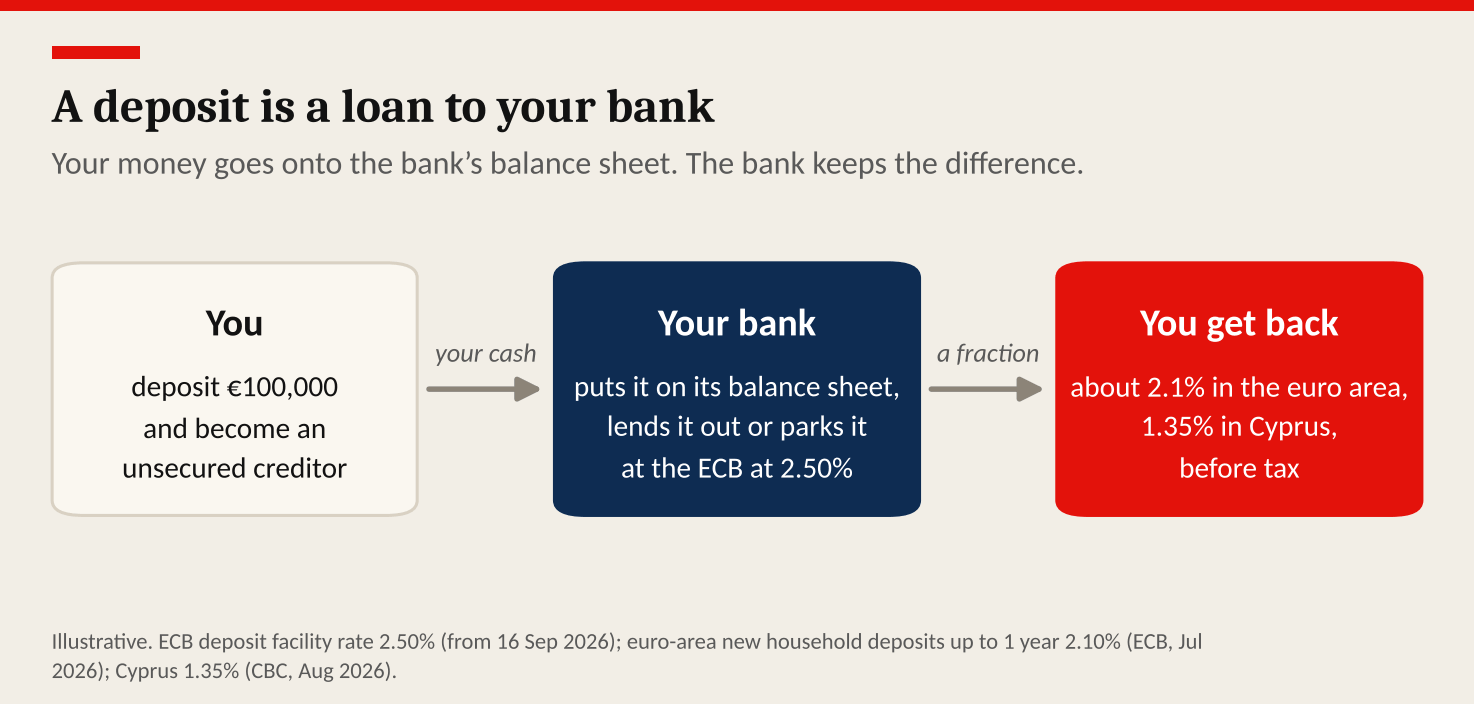

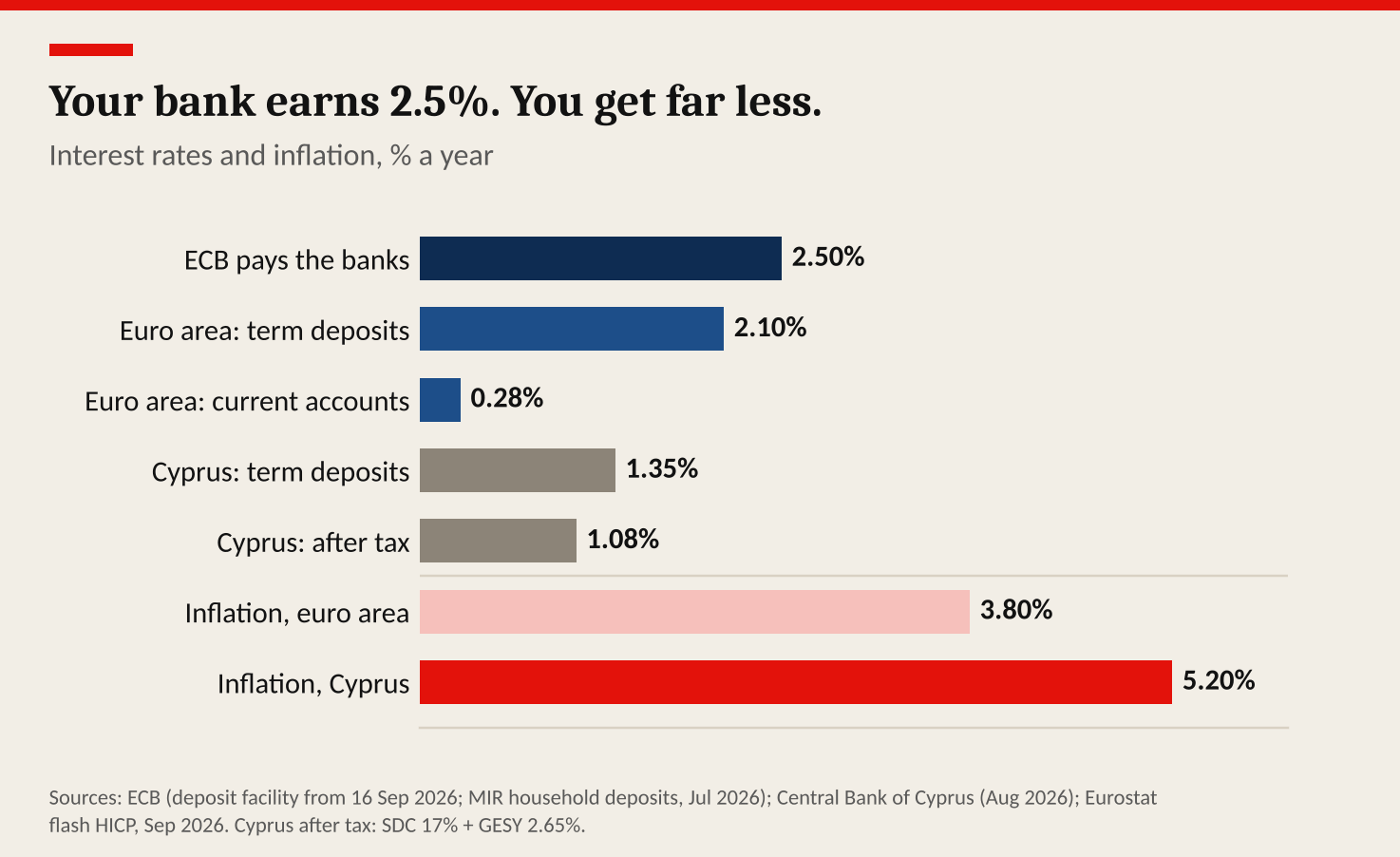
Since September, the ECB pays banks 2.50% a year on the cash they park with it, at no risk.4 Across the euro area, new term deposits pay households about 2.10% and current accounts just 0.28%.5 With euro-area inflation at 3.8%,6 most savers are already losing money in real terms.
The problem is most acute in southern Europe, and in Cyprus above all. Two banks hold around 80% of the market,7 competition is thin, and new term deposits pay 1.35%,8 among the lowest rates in the euro area. After tax, a Cypriot depositor keeps 1.08%,9,14 against inflation of 5.2%.10


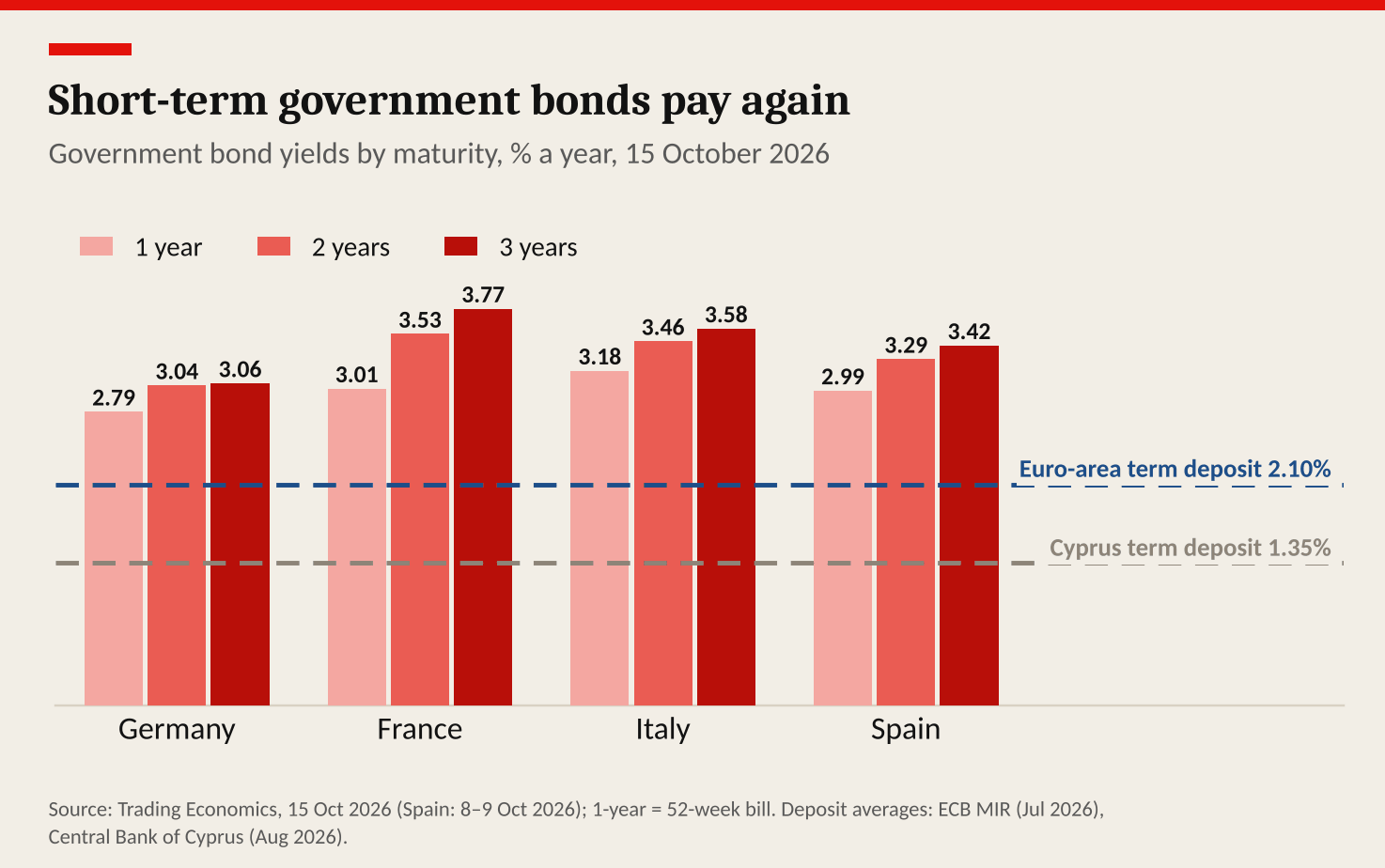
After a decade of zero and negative rates, short-term government bonds now pay meaningfully more than deposits in every major euro-area country. At two to three years, German, French, Italian and Spanish government bonds yield 3.0–3.8%:1 one to almost two points more than the average euro-area deposit, and more than double a Cypriot one.
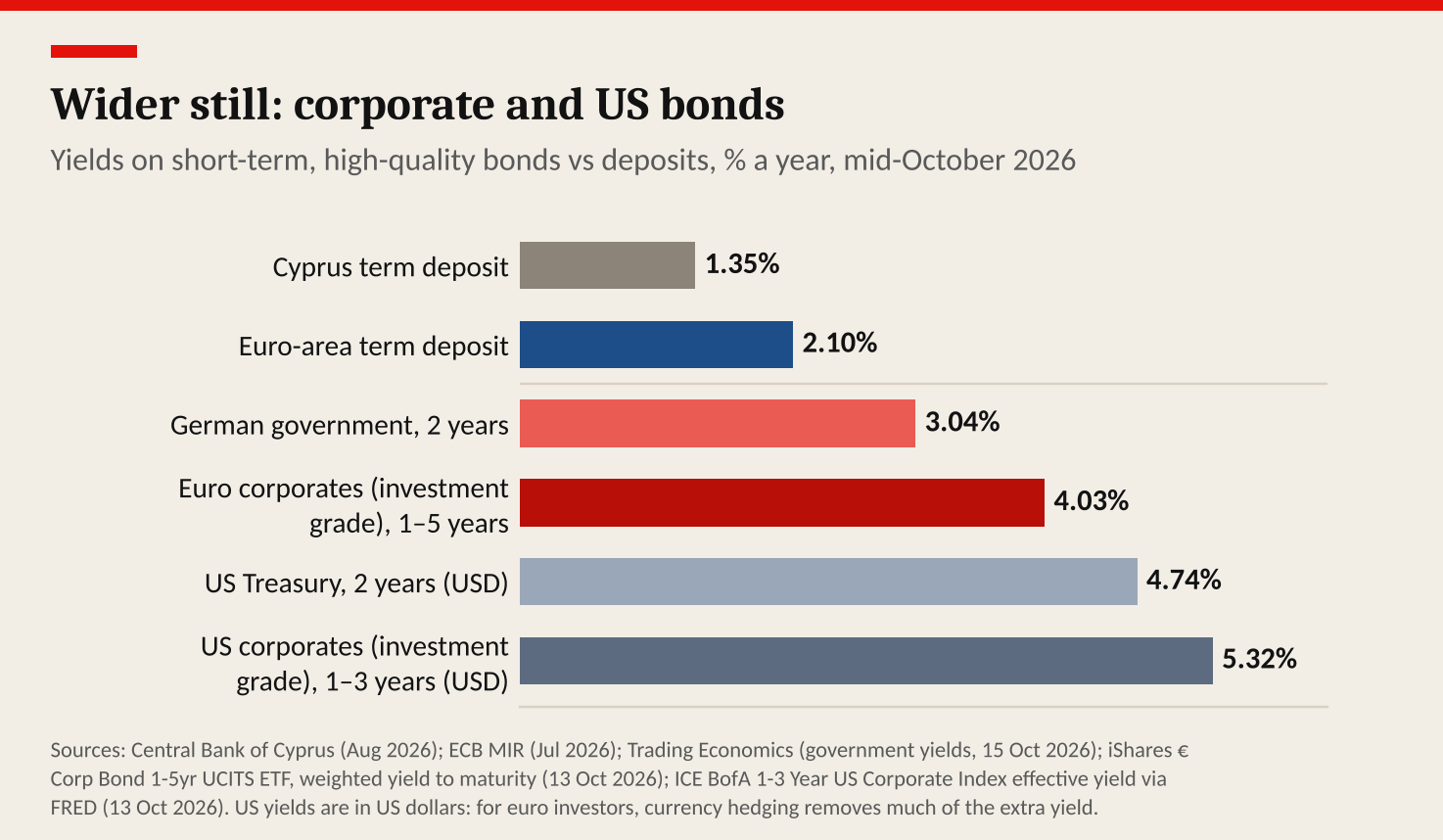
The opportunity is wider than government bonds. Short-dated, investment-grade corporate bonds, issued by large and financially solid companies, add a further premium: a diversified ETF of euro corporate bonds maturing in one to five years currently yields about 4.0%.11 US Treasuries and US corporate bonds yield more still, 4.5–5.3%,12 though for euro investors they come with currency risk, and hedging that risk removes some of the extra yield. Used appropriately, these instruments can improve yield and diversification, provided the associated credit, market and currency risks are actively managed.

There is no need to buy individual bonds. UCITS exchange-traded funds (ETFs) holding short-term, high-quality government and corporate bonds offer access to these yields through a single investment. Their costs are typically well below those of actively managed funds, and they can normally be sold on any trading day while the exchange is open, subject to market liquidity.¹³


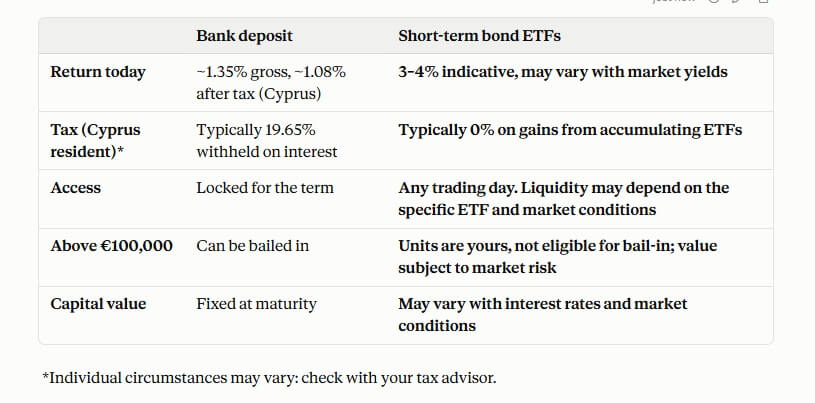
Every year that €100,000 sits in a Cypriot deposit, it earns about €1,080 after tax. At today’s indicative yields, the same amount in short-term bonds could earn €3,000–4,000.¹⁶ Over five years, that gap compounds to roughly €10,000–16,000 left with the bank, which already earns around 2.5% on your money.⁴
The higher yield is not free. Bond ETF returns are not guaranteed and are exposed to market and credit risk: prices move with interest rates, and issuers can be downgraded or default. Even in low-risk bonds, the result depends on which bonds are held, at what maturity, and how the portfolio responds as conditions change.
And the choice is not simple. Hundreds of bond ETFs are available in Europe, differing widely in cost, liquidity, credit quality, maturity and currency. Numisma selects high-quality, liquid ETFs from this universe, combines them into a portfolio diversified across countries and between government and corporate issuers, and monitors it continuously.
This is Numisma Liquid Yield: a dedicated strategy designed to provide efficient exposure to short-term bonds.
If you would like to see how this could work for you, just get in touch:
Email: wm@numismagroup.com Website: invest.numismagroup.com
Sources
Numbered references in the text correspond to the sources below. Market data (sources 1, 11 and 12) are from Bloomberg as of mid-October 2026 and fluctuate daily; official statistics and legal sources carry their publication dates. All sources were accessed on 15 October 2026.
1. Government bond yields, 2- and 3-year. Bloomberg, as of mid-October 2026: German, French, Italian and Spanish government bonds, 2- to 3-year maturities. Market yields fluctuate daily.
2. Deposit guarantee of €100,000. Directive 2014/49/EU on deposit guarantee schemes, Article 6(1), EUR-Lex; transposed in Cyprus as the Deposit Guarantee and Resolution of Credit and Other Institutions Scheme, administered by the Central Bank of Cyprus.
3. 2013 Cyprus bail-in. European Stability Mechanism, FAQ on financial assistance for Cyprus (18 Sep 2013): 47.5% of uninsured deposits (above €100,000) at Bank of Cyprus converted into equity; uninsured deposits at Laiki placed in a legacy entity. Resolution framework now EU-wide under Directive 2014/59/EU (BRRD).
4. ECB deposit facility rate 2.50%. European Central Bank, Key ECB interest rates: deposit facility 2.50% with effect from 16 September 2026 (Governing Council decision of 10 September 2026; previously 2.25% from 17 June 2026).
5. Euro-area deposit rates. European Central Bank, Euro area bank interest rate statistics: July 2026 (2 Sep 2026): new deposits from households with agreed maturity up to one year 2.10%; overnight deposits 0.28%. The August 2026 release (1 Oct 2026) shows 2.13% and 0.29%.
6. Euro-area inflation 3.8%. Eurostat, Euro area annual inflation up to 3.8%, flash estimate for September 2026 (2 Oct 2026).
7. Two banks hold around 80% of the Cyprus market. Numisma estimate from: Central Bank of Cyprus monetary and financial statistics, total deposits €58.7bn in June 2026 (reported by Cyprus Mail, 27 Jul 2026); Bank of Cyprus deposits €22.3bn at 31 March 2026 (Cyprus Mail, 11 May 2026); Eurobank Cyprus and Hellenic Bank combined deposits €23.5bn pro forma, about 42% market share (EY Cyprus Banking Bulletin, Aug 2025; CBN, 13 Jun 2025). Combined share of deposits approximately 78–80%.
8. Cyprus deposit rate 1.35%. Central Bank of Cyprus, Statistics on interest rates applied by monetary financial institutions, reference month August 2026 (published October 2026): new household deposits with agreed maturity up to one year 1.35%, up from 1.27% in July; as reported by Cyprus Mail, 5 Oct 2026.
9. After-tax deposit return 1.08% and real return −3.9%. Numisma calculation: 1.35% × (1 − 19.65%) = 1.08%; real return (1 + 1.08%) ÷ (1 + 5.2%) − 1 = −3.9%. Inputs from sources 8, 10 and 14.
10. Cyprus inflation 5.2%. Eurostat, flash estimate for September 2026, country table (source 6); Cyprus Statistical Service, HICP September 2026.
11. Euro corporate bond ETF yield about 4.0%. Bloomberg, as of mid-October 2026: weighted average yield to maturity of a diversified UCITS ETF of euro-denominated investment-grade corporate bonds maturing in one to five years. Named as an example of the asset class, not a recommendation; yields fluctuate daily.
12. US yields 4.5–5.3%. Bloomberg, as of mid-October 2026: US Treasury yields at short maturities and the yield on short-dated (1–3 year) US investment-grade corporate bonds. Yields fluctuate daily; for euro investors, returns are also affected by currency movements.
13. UCITS ETFs: daily dealing and segregated custody. Directive 2009/65/EC (UCITS), Articles 22–26 on the depositary and safekeeping of fund assets, EUR-Lex; Directive 2014/65/EU (MiFID II), Article 16(8) on safeguarding client financial instruments, EUR-Lex.
14. Tax on deposit interest in Cyprus: 17% SDC plus 2.65% GESY. Special Defence Contribution Law N.117(I)/2002 as amended: SDC on interest reduced from 30% to 17% from 1 January 2024, unchanged under the 2026 tax reform; General Healthcare System Law N.89(I)/2001: 2.65% on interest income of individuals. See Mondaq, Passive income taxation, 17 Jan 2024 and Cyprus Tax Reform 2026. Applies to Cyprus tax-resident and domiciled individuals.
15. Gains on disposal of securities exempt from tax. Income Tax Law N.118(I)/2002, Article 8(22): profits from the disposal of titles (shares, bonds, debentures and similar instruments, including fund units) are exempt from income tax; see PwC Tax Summaries, Cyprus: Individual income determination (last reviewed 4 Aug 2026).
16. Illustration on €100,000. Numisma calculation: €100,000 × 1.08% ≈ €1,080 a year; €100,000 × 3–4% = €3,000–4,000 a year; over five years, compounded, the difference is about €10,000–16,000. Indicative, before fees; returns are not guaranteed.
17. Investor Compensation Fund €20,000. Cyprus Securities and Exchange Commission, Investor Compensation Fund for clients of CIFs (Directive DI87-07): maximum compensation €20,000 per covered client.
Important information
Marketing communication. Issued by Numisma Capital Ltd (“Numisma”), a Cyprus Investment Firm authorised and regulated by the Cyprus Securities and Exchange Commission (CySEC), licence no. 122/10. Registered office: 132 Kyrenias Avenue, 2nd Floor, 2113 Aglantzia, Nicosia, Cyprus. Not prepared in accordance with legal requirements designed to promote the independence of investment research.
Not advice or an offer. For information only; not investment, tax or legal advice, a personal recommendation, or an offer to buy or sell any financial instrument or service. Any investment is subject to an appropriateness or suitability assessment, the applicable client agreement and Numisma’s ex-ante disclosure of costs and charges.
Low risk, not no risk. The value of investments can fall as well as rise, and you may get back less than you invest, for example if interest rates rise sharply, a bond issuer is downgraded or markets are under stress. The strategy is not a bank deposit and is not covered by the Deposit Guarantee Scheme.
Returns, illustrations and costs. Yields are indicative and returns are not guaranteed. Illustrations are not forecasts; forecasts and past performance are not reliable indicators of future results. Figures are shown before management fees, which vary with the custodian chosen and the amount invested and reduce the return; full costs are disclosed before investing. Where an ETF is not denominated in euro, currency movements also affect returns.
Tax. Tax information refers to Cyprus tax-resident, domiciled individuals and is general in nature. Tax treatment depends on each client’s individual circumstances and may change in the future.
Investor protection. Numisma is a member of the Investor Compensation Fund for clients of Cyprus Investment Firms (ICF); eligible clients may be compensated up to €20,000 under the ICF’s terms.17 Assets held with third-party custodians are subject to the custodian’s segregation rules and compensation schemes.
Liability. Third-party information is believed to be reliable but has not been independently verified and may change without notice. To the extent permitted by law, Numisma accepts no liability for any loss arising from the use of this article, which may not be reproduced without its prior written consent and is governed by the laws of the Republic of Cyprus.